
The short version
If your zoning district allows single-family homes, you can add one accessory dwelling unit (ADU) without a special permit: inside the house, attached, or in a separate cottage, garage or barn. The state calls it a Protected Use ADU.
- Size: no larger than half the main house's gross floor area or 900 sq ft, whichever is smaller. Your town may allow more.
- No owner occupancy rule. You don't have to live in either unit.
- Parking: a town can require one extra space at most, and none if any part of your lot is within half a mile of a qualifying transit station.
- Renting is allowed. Towns can restrict or ban short-term rentals of 31 days or less.
- One per lot. A second ADU on the same lot always needs a special permit.
- By right is not permit-free. You still need a building permit, full building-code compliance and, on septic, Title 5.
What the law says, and since when
The rules come from the Affordable Homes Act (Chapter 150 of the Acts of 2024), approved August 6, 2024, which rewrote the ADU definition in the Zoning Act (M.G.L. c.40A, s.1A) and made a single ADU a protected use under c.40A, s.3. The protection took effect on February 2, 2025; from that date, local zoning that conflicts with it is unenforceable. The state's regulations, 760 CMR 71.00, took effect January 31, 2025.
The law covers 350 of the state's 351 municipalities; Boston has its own ADU rules. EOHLC's survey counts 2,824 ADU applications and 2,084 approved ADUs statewide in 2025 and the first half of 2026.
Under c.40A, s.3, zoning may not prohibit, unreasonably restrict, or require a special permit or other discretionary approval for a single ADU, or its rental, in a single-family residential zoning district. EOHLC reads that broadly: any district where single-family homes are allowed, by right or by special permit, overlays included.
What counts as an ADU
An ADU is a self-contained unit with its own sleeping, cooking and sanitary facilities, on the same lot as a principal dwelling, with its own entrance: directly from outside, or through a shared hall that meets building-code egress.
- Internal: a basement, attic or wing of the existing house turned into a separate unit.
- Attached: a new addition built as its own unit, the classic in-law apartment.
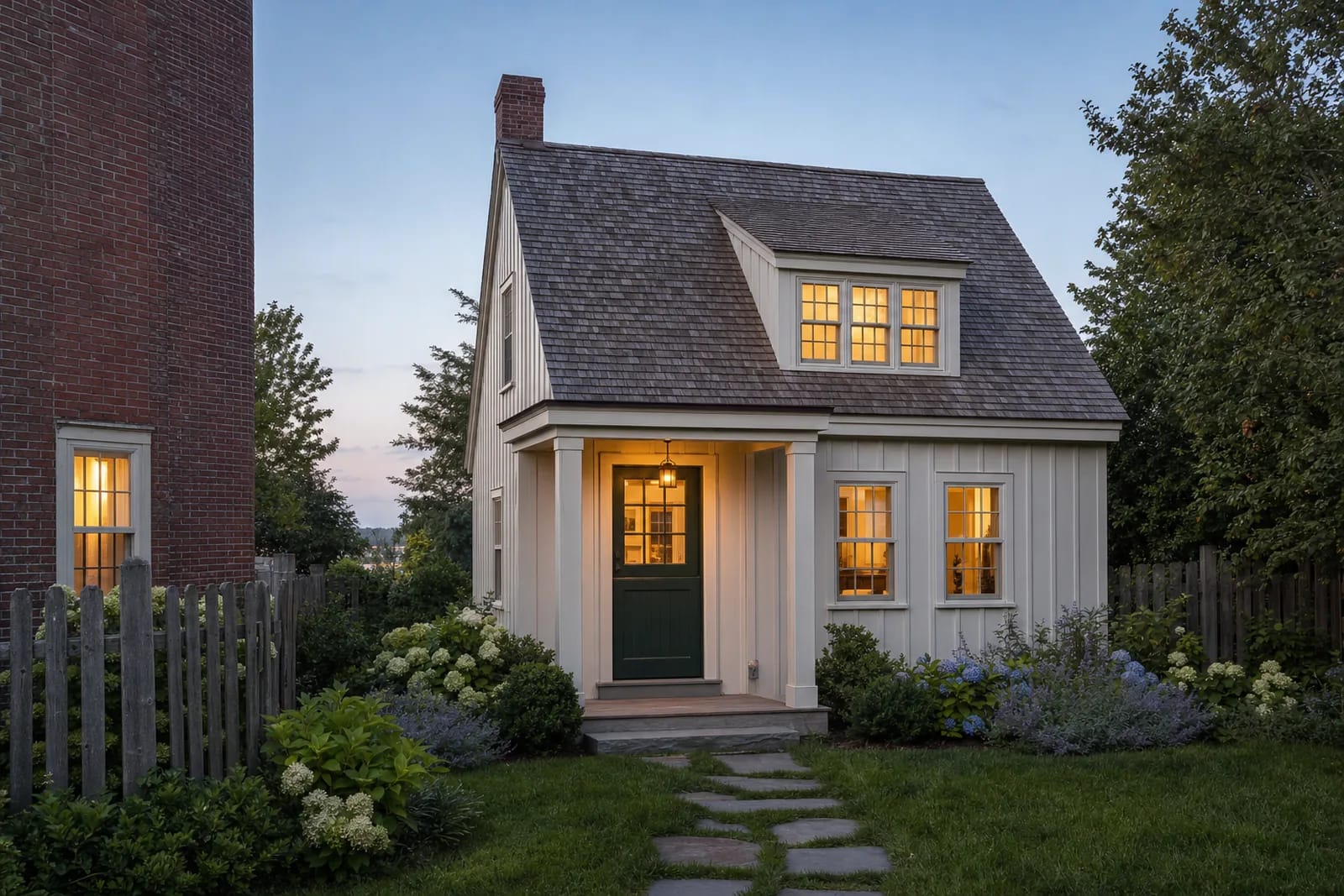
- Detached: a backyard cottage, or an existing garage, barn or carriage house converted to living space.
The main house can be a two-family or a triple-decker; the Attorney General's East Bridgewater decision (April 14, 2025) confirmed towns can't limit ADUs to single-family lots. Modular units on a foundation qualify too. A suite without its own kitchen, or without its own entrance, is not an ADU; it's an in-law suite, which is part of the house. We compare the two in ADU vs addition.
How big an ADU can be
The cap is the smaller of two numbers: 900 sq ft, or half the gross floor area (GFA) of the main house. A house with 1,600 sq ft of GFA can have an 800 sq ft ADU. A house with 2,400 sq ft of GFA tops out at 900.
Under 760 CMR 71.02, GFA is the sum of every story with code-compliant ceiling height, basements and lofts included, measured from the inside faces of the exterior walls. It excludes crawl spaces, garage parking areas, attics and enclosed porches.
EOHLC says a town can't cap a Protected Use ADU below 900 sq ft but may allow larger ones. That is the agency's reading; the statute still lets towns add size restrictions that are not unreasonable. Several North Shore towns have created larger ADU categories by special permit (see the town table below).
What your town can and can't require
Some local rules are banned outright. Others are allowed if reasonable: under 760 CMR 71.03(3)(a), a rule fails if it serves no legitimate municipal interest, doesn't rationally relate to that interest as applied, or would nullify the ADU or impose excessive cost without significantly advancing it.
| Topic | Towns can't | Towns can |
|---|---|---|
| Permits | Require a special permit or other discretionary approval | Require a building permit and clear, objective site plan review |
| Who lives there | Require owner occupancy; restrict by income, age, family relationship or student status; limit occupants or bedrooms beyond state code | Apply state building, fire and sanitary codes |
| How many | Cap or set quotas on ADUs town-wide, or count them in density calculations | Require a special permit for a second ADU on the same lot |
| Lot and size | Require a minimum lot size or lot-area formulas; cap the ADU below 900 sq ft (EOHLC's reading) | Allow ADUs larger than the state cap |
| Form | Require the ADU to be attached, or to be detached | Apply clear, objective design standards that also apply to single-family homes |
| Dimensions | Apply setbacks, height or bulk limits stricter than the most permissive of the house, a single-family home or an accessory structure in that district | Apply those dimensional limits, and stricter design and dimensional standards inside a local historic district |
| Parking | Require more than one extra space, or any space within half a mile of qualifying transit | Require one extra space elsewhere |
| Utilities | Require a separate water, sewer or electric connection by town rule | Nothing on its own; a utility, state law, a board or commission, or a court can still require one |
| Rentals | Prohibit renting the ADU | Restrict or prohibit short-term rentals |
| Septic | Apply Title 5 more strictly than it applies to a single-family home in the district | Apply Title 5 (310 CMR 15.000); stricter local board of health rules must pass the reasonableness test |
Nonconforming lots. Many older North Shore houses sit closer to the line than today's setbacks allow. A pre-existing nonconforming structure or lot can't be used to block an ADU that can be built in compliance with the code and state law. Work that doesn't meet setbacks or other dimensional rules can still need a c.40A, s.6 finding or a variance, so ask how your town handles it. Overlays are the exception to watch: in a floodplain or aquifer-protection overlay, a town may require a special permit for an ADU if the house itself would need one. On the coast, that matters; see coastal homes.
Parking and the half-mile transit rule
A town can require at most one extra parking space, and none if any part of your lot is within half a mile of a commuter rail, subway or bus station or a ferry terminal (760 CMR 71.03(2)(b)).
Rail stations and ferry terminals count only with year-round service, and EOHLC says flag stops are not bus stations. On the North Shore, the Newburyport/Rockport line puts many village-center lots inside the radius. Beverly Farms station is active; Prides Crossing has had no service since December 14, 2020, so it would not count. Measure from your property line, not the house.
Renting it out
The statute protects the ADU and its rental, so a town can't stop you renting to a long-term tenant. Towns can restrict or prohibit short-term rentals. That means stays of 31 consecutive days or fewer (M.G.L. c.64G). Many North Shore towns that have rewritten their bylaws, including Hamilton, Manchester-by-the-Sea, Ipswich, Nahant, Topsfield, Wenham and Newbury, have banned short-term rental of ADUs.
Selling the ADU separately is a condominium question under M.G.L. c.183A, not the ADU law (the Attorney General's Georgetown decision, June 16, 2025), and several North Shore bylaws, including Hamilton's, Topsfield's and Wenham's, bar separate ownership. The ADU law doesn't address homeowners' associations either.
One per lot, and the second needs a special permit
Only one ADU per lot can be a Protected Use ADU. A town may allow more, but any additional ADU needs a special permit. Some towns have also created larger ADU categories by special permit. These notes are from our town research, as of September 2026.
| Town | What's different locally |
|---|---|
| Hamilton | Detached Large ADU over 900 and up to 2,000 sq ft (never more than half the house) by Planning Board special permit. No short-term rentals; written Board of Health septic verification with the permit application. |
| Manchester-by-the-Sea | Large ADU up to 1,200 sq ft or half the house by ZBA special permit, with a six-month minimum lease. No short-term rentals. |
| West Newbury | Special Permit ADU from 900 up to 1,500 sq ft (never more than half the house), only with an owner-occupied single-family home. |
| Newbury | ZBA may allow up to 15% more than 900 sq ft by special permit. Applications need an engineer- or surveyor-stamped site plan and architect-stamped floor plans and elevations. |
| Beverly | 2023 ordinance allows up to 1,000 sq ft or half the house. Amendments to align with state law were set for a May 2026 hearing; final adoption not confirmed. |
| Marblehead | Bylaw aligned with state size and parking rules in May 2025. 2026 amendments were reported as awaiting Attorney General review in July 2026; confirm the rules in force with Planning staff. |
| Ipswich | By right, with possible Site Plan Review and a required septic evaluation. A revised local amendment is on the October 20, 2026 Town Meeting warrant. |
| Wenham | A detached ADU must satisfy the Fire Code (527 CMR 1.00), and the town's FAQ treats it as a new building under the Specialized energy code once that takes effect. |
By right still means a building permit
Every ADU needs a building permit and full code compliance. The Massachusetts building code (780 CMR, 10th Edition) doesn't use the term ADU; it asks whether the space is a dwelling unit, with complete, independent provisions for living, sleeping, eating, cooking and sanitation.
- An internal or attached ADU turns the house into a two-family under the Residential Code. The two units must be separated by 1-hour fire-rated walls and floor-ceiling assemblies, or 1/2-hour if the whole building is sprinklered (IRC R302.3), with supporting construction rated at least as high.
- A detached ADU is built like a new single-family house under the Residential Code. Its exterior walls don't need a fire rating just because it shares the lot.
- Adding a unit to an existing two-family is different. It becomes a three-unit R-2 building under the Commercial and Existing Building Codes, which can trigger major upgrades depending on the building.
- Life safety. The new unit needs its own smoke and CO alarms (photoelectric smoke alarms in Massachusetts), escape openings in rooms that become bedrooms, and 7-foot ceilings in habitable rooms (6 feet 8 inches in baths, laundry rooms and basement living space).
- Sprinklers aren't required in a one- or two-family dwelling unless its aggregate area exceeds 14,400 sq ft, or it is a primarily owner-occupied short-term rental lodging house.
After final inspections the building official issues a certificate of occupancy, and the new ADU gets its own address under the MassGIS standard.
Septic: Title 5 still applies
Much of the North Shore isn't on town sewer. Hamilton, Wenham, Topsfield and West Newbury are largely or entirely on private septic, and Gloucester, Ipswich, Manchester and Newbury are mixed. There, Title 5 (310 CMR 15.000) is often the real constraint, and the ADU statute lets towns apply it.
- Design flow is 110 gallons per day per bedroom, with the house and the ADU counted separately.
- An ADU that adds bedrooms is New Construction under Title 5, whether it shares the existing system or gets its own.
- A shared system needs a two-compartment tank or two tanks in series, with narrow exceptions; the minimum tank is 1,500 gallons.
- A Title 5 inspection is required first. A cesspool must be upgraded either way, and tight tanks are not allowed.
Stricter local board of health rules must pass the reasonableness test when applied to a protected ADU. The practical advice is simpler: get the septic evaluated before you pay for design. More in our guide to Title 5 and adding bedrooms.
Energy code: ADUs have their own targets
Massachusetts has three energy code tiers: Base, the opt-in Stretch code and the opt-in Specialized code. Towns change tiers, so check DOER's live list. On the North Shore, Salem, Swampscott, Newburyport, Beverly and Andover are on the Specialized code per DOER's June 2026 list, with Wenham scheduled for January 1, 2027. Danvers, Essex, Groveland, Lynnfield and Middleton are Base. Most of the rest, including Peabody, Marblehead, Gloucester, Hamilton and Ipswich, are Stretch.
Under the Stretch code (Table R406.5), ADUs get their own, less strict HERS limits than new houses: 52 mixed-fuel, 55 with solar or all-electric, 58 with solar plus all-electric, against 42 to 45 for a new home. The Specialized code's Zero Energy and Mixed-Fuel pathways also have ADU limits; its All-Electric pathway has no separate ADU column.
What's changing: the proposed 2026 revisions
EOHLC has proposed revisions to 760 CMR 71, with public comment open until 11:59 p.m. on October 9, 2026. They are proposed, not in effect. As drafted, they would:
- Exclude common areas, enclosed exterior stairs, breezeways and egress areas from the ADU's floor area.
- Bar short-term-rental rules that require leases longer than 32 consecutive days.
- Bar requiring a separate or common utility connection or septic system, dropping today's exceptions.
- Treat the Specialized energy code as the minimum where a town has opted in.
- Add minimum lot area to the prohibited list.
- Allow affordability or year-round occupancy limits only with municipal funding or land, or in designated seasonal communities.
- Limit c.40A, s.6 nonconformity findings to clear, objective, as-of-right review.
We'll update this guide when they are final.
How we take an ADU from idea to permit
Most of the hard questions are answered before anyone draws a floor plan. We pull the zoning and the town's current ADU rules, check for historic, wetlands and flood overlays, confirm sewer or septic and the energy-code tier, and measure the house so the size cap comes from real gross floor area. Then we design it with you in 3D and price it line by line, with allowances called out. As a registered Home Improvement Contractor (MA HIC #198443) we pull the building permit. More on our ADU page.
Questions homeowners ask
Can I build an ADU in Massachusetts without a special permit?
Yes: one ADU per lot, in any district that allows single-family homes, within the state definition and size cap. You still need a building permit. A second ADU, or one in an overlay where the house itself would need a special permit, can require one.
Do I have to live on the property?
No. Towns can't require owner occupancy of either the ADU or the main house for a Protected Use ADU, even if an older local bylaw still says so.
Can I rent my ADU on Airbnb?
Long-term rental is protected. Short-term rental of 31 days or less can be restricted or banned by your town, and many North Shore towns that have updated their bylaws have banned it for ADUs.
Sources
- EOHLC: Accessory Dwelling Units (law, regulations, 2026 draft, survey data)mass.gov
- EOHLC: ADU FAQs (updated September 17, 2026)mass.gov
- 760 CMR 71.00, Protected Use ADUs (as published January 31, 2025)mass.gov
- 2026 informational draft 760 CMR 71 redlines (proposed, not in effect)mass.gov
- Chapter 150 of the Acts of 2024 (Affordable Homes Act)malegislature.gov
- M.G.L. c.40A, s.1A (definitions, including ADU)malegislature.gov
- M.G.L. c.40A, s.3 (ADU protected use)malegislature.gov
- DOL/OPSI district meeting deck: ADUs and Tiny Houses under the 10th Edition (hosted by the Town of Lexington)lexingtonma.gov
- 780 CMR 10th Edition, Residential Chapter 3 amendmentsmass.gov
- MassDEP: Guidance on Title 5 compliance for ADUsmass.gov
- MassDEP: Title 5 ADU FAQ (revised September 11, 2025)mass.gov
- 225 CMR 22.00, Stretch and Specialized Code for low-rise residential (February 14, 2025)mass.gov
- DOER: Building energy code adoption by municipalitymass.gov
This guide explains the rules in plain language. It is not legal advice. Local bylaws change, and every lot is different, so check with your town before you design.