The short answer: in a Stretch or Specialized code town, an addition of more than 1,000 square feet of conditioned space, or one that more than doubles the house, needs a HERS rating on the whole house, with a maximum score between 65 and 75 depending on fuel and solar. Smaller additions are built to the prescriptive insulation, air-sealing and duct rules. Which code applies depends only on your town, so that is the first thing to check.
Everything below comes from the state's own documents: 225 CMR 22.00 (the Stretch and Specialized code text dated February 14, 2025), the 10th Edition Massachusetts Residential Code, the Department of Energy Resources (DOER) FAQ, and DOER's municipal adoption list. Town-by-town details are at the end.
Three energy codes, one per town
All three Massachusetts codes are built on the 2021 International Energy Conservation Code (IECC). What differs is how far each one goes past it, and a town only gets the stricter versions by voting them in.
- Base code. The IECC 2021 with Massachusetts amendments, in 780 CMR Chapter 11R for houses. It applies anywhere a town has not adopted anything else. New homes can comply prescriptively, through Passive House certification, or with a HERS rating of 52 or lower.
- Stretch code. 225 CMR 22.00 for low-rise residential buildings. Opt-in by town meeting or city council. New homes are held to HERS 42 to 45 (or Passive House), and large additions trigger a whole-house HERS rating.
- Specialized code. 225 CMR 22.00 plus Appendix RC. Also opt-in. It targets new construction: net-zero pathways, all-electric or solar-backed mixed-fuel homes. Existing houses follow the Stretch code's Chapter 5.
As of DOER's June 4, 2026 count, 242 municipalities have adopted the Stretch code since 2010 and 60 have adopted the Specialized code since 2023 (the Specialized towns are counted in the 242). About 7 percent of Massachusetts residents live in a Base code community. On the North Shore that minority includes Danvers, Essex, Lynnfield and Middleton.
What the Stretch code asks of an addition
Additions up to 1,000 square feet
An addition of 1,000 square feet of conditioned floor area or less, which is most family rooms, primary suites and kitchen bump-outs, must meet the relevant requirements of IECC sections R402, R403 and R404: insulation levels and fenestration U-factors (R402), mechanical systems, ducts and controls (R403), and lighting (R404). DOER's FAQ describes these smaller projects as continuing to follow the Base code. No HERS rating is required.
In practice that means the new walls, roof and floor of the addition hit the prescriptive R-values, the air barrier is continuous and inspected, and any new ductwork is sealed and tested as the code requires. The existing house is not dragged along with it.
Additions over 1,000 square feet, or more than doubling the house
Section R502.1.1 of the Stretch code covers large additions: anything over 1,000 square feet of conditioned area, or over 100 percent of the existing conditioned floor area. For those, the whole house, old and new together, has to meet the HERS limits for additions. That is the rule that changes budgets, because the existing house is now part of the score.
| Project | Mixed fuel | Mixed fuel + solar | All-electric | All-electric + solar |
|---|---|---|---|---|
| New house | 42 | 42 | 45 | 45 |
| Accessory dwelling unit | 52 | 55 | 55 | 58 |
| Major alteration, addition or change of use | 65 | 70 | 70 | 75 |
Lower is better on a HERS index. A new house can score 3 points higher with the code's embodied-carbon credit. Section R406.5.1 also lists clean-energy trade-offs for fully attached additions, Level 3 alterations and changes of use: a solar array of 4 kW or more offsets 3 HERS points, and going all-electric offsets 3 points per dwelling unit.
- Additions add up. DOER's FAQ says multiple additions to the same dwelling count together toward the 1,000 square foot trigger. Two 600 square foot additions are treated as 1,200.
- Only conditioned area counts. An unheated garage or a screened porch does not push you over.
- Finishing existing space is exempt. Converting an existing basement or attic to conditioned space without changing the footprint or the roofline needs no HERS rating.
- A HERS rating includes a blower-door test. A rater pressurizes the house and measures the leakage, so the old house's air sealing matters, not only the new wing's.
Major renovations and alterations
Renovating inside an existing house rarely triggers a HERS rating. Level 1 and Level 2 alterations and repairs follow Chapter 5 of the code. DOER's FAQ says an alteration needs a HERS rating only when it is both a Level 3 alteration under the Existing Building Code (or an extensive alteration under IRC Appendix AJ) and larger than 1,000 square feet or 100 percent of the existing floor area.
So a kitchen and two baths taken to the studs is an alteration that meets prescriptive rules for whatever it touches: insulation in opened exterior walls, sealed ducts, efficient lighting. A whole-house gut of a 2,400 square foot colonial can be a different conversation, and the building official decides the classification. Ask early.
EV-ready and solar-ready requirements apply to new construction, not to alterations. Historic buildings get some latitude. Footnote c to Table R406.5 lets a historic building follow R503.1.1 for alterations instead of the HERS limits, and DOER's FAQ cites IECC C501.5, which makes repair and alteration provisions non-mandatory where a registered design professional or historic preservation authority reports that compliance would threaten the building's historic form, fabric or function. If you own an older house in a local historic district, that report is worth discussing with your designer.
ADUs and the energy code
The Stretch code gives accessory dwelling units their own, less strict column: HERS 52 for mixed fuel, 55 with solar or all-electric, and 58 with solar plus all-electric, against 42 to 45 for a new house. The Specialized code's Zero Energy pathway allows 55 for an all-electric ADU and 52 for a mixed-fuel one, but also requires the unit to reach HERS 0 once on-site power is counted. Its Mixed-Fuel pathway allows 55. Its All-Electric pathway has no ADU column at all, so the limit there is 45, or 48 with the embodied-carbon credit.
One honest caveat: none of the state documents we checked says exactly how those ADU numbers apply to a unit created inside an existing house, as opposed to a new detached cottage. Wenham's April 2026 Specialized code FAQ is a useful local reading: a detached ADU, including a cottage or a detached garage rebuilt as an ADU, counts as a new building, while an interior conversion or an attached addition stays under the Stretch code. Other towns may read it differently, so the building official's answer is the one that counts.
EOHLC's proposed revisions to the ADU regulations (760 CMR 71) would treat the Specialized code as the state minimum for ADUs where a town has opted in. That draft is open for public comment until October 9, 2026 and is not in effect. For the zoning side, see our guide to the Massachusetts ADU law and how we approach ADUs and in-law suites.
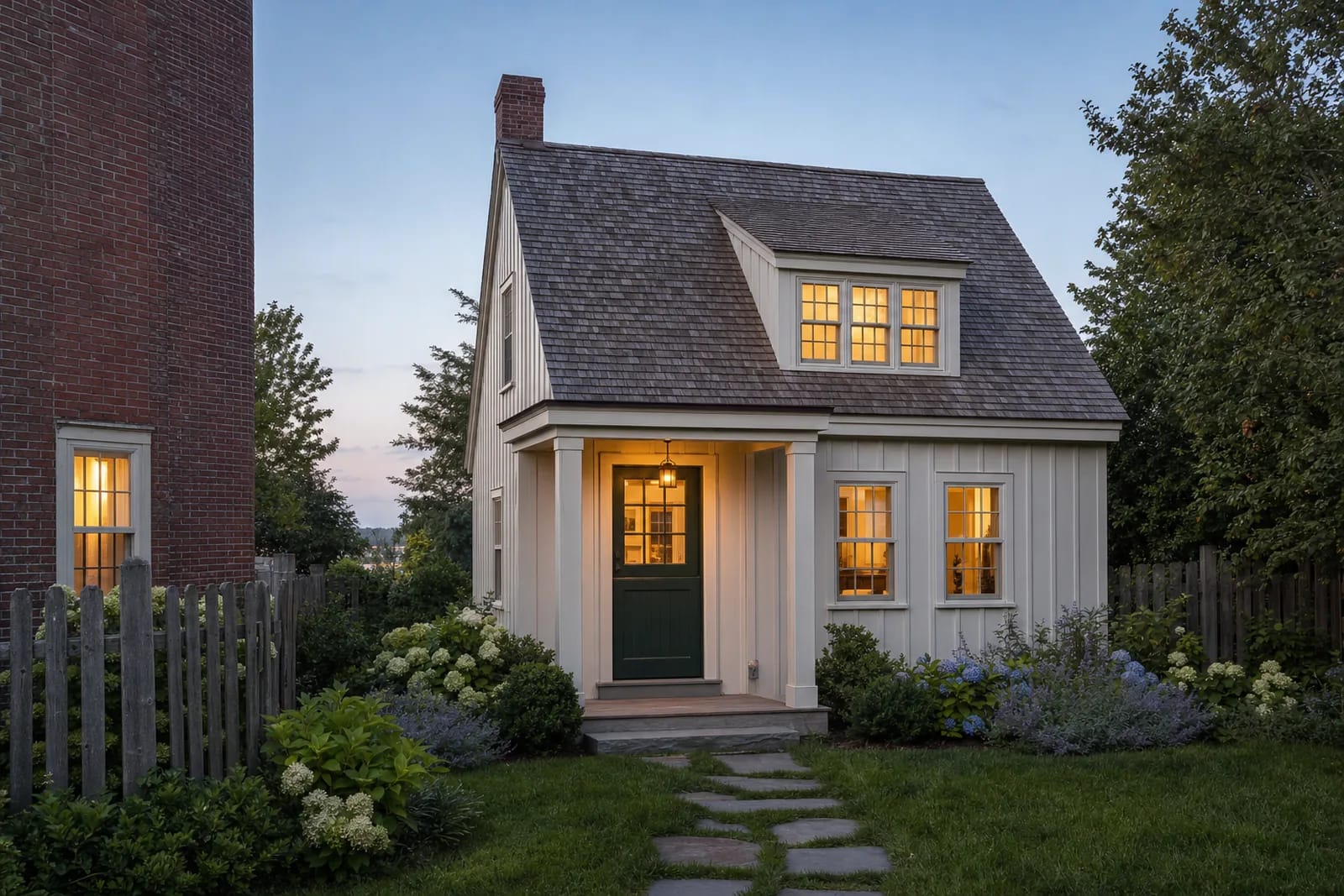 Concept rendering
What the Specialized code adds
The Specialized code is about new houses. New residential buildings must be net zero through one of three pathways: Zero Energy (or Passive House), All-Electric, or Mixed-Fuel. New homes over 4,000 square feet of conditioned floor area must use the Zero Energy or All-Electric pathway. Mixed-fuel houses must be pre-wired for future electric equipment, and a new mixed-fuel one- or two-family home needs at least 4 kW of on-site solar per dwelling unit, unless its potential solar zone is under 300 square feet.
For existing houses, the Specialized code points back to Chapter 5 of the Stretch code. The cities and towns that have published guidance say the same thing. Salem says additions and alterations follow the Stretch code with nothing extra. Andover says the Specialized code covers new construction only, and additions, renovations and historic buildings stay on the Stretch code. Where it really bites on the North Shore is the teardown-and-rebuild: a new house in Swampscott, Salem, Beverly Farms or Newburyport is designed to Specialized rules from the first sketch.
The Specialized code does not ban gas. It makes a mixed-fuel new house carry solar and electric readiness, and it steers big houses toward all-electric or zero-energy design.
Base code towns
In Danvers, Essex, Lynnfield and Middleton, the Base code applies. Additions there follow Chapter 5 of the IECC as amended: prescriptive requirements for the new work, or a HERS-based performance path for the addition and any alterations that go with it (R502.1.2). The 1,000 square foot whole-house HERS trigger is a Stretch code provision. It does not appear in the Base code amendments.
Two notes. Essex adopted the Stretch code in 2015 and rescinded it by citizen petition at the May 2023 town meeting, so it is Base today. Danvers, a municipal-light town, became eligible for the Green Communities program only after a 2022 state law change; the town's resilience site describes a possible February 2027 vote that would put the Stretch code into effect July 1, 2027. That is a plan, not an adoption.
North Shore energy code by town
This schedule is built from DOER's municipal adoption list, data as of June 4, 2026, read directly from the state's published table, and checked against our own research on each town. Beverly Farms and Prides Crossing are part of the City of Beverly and follow Beverly's code. Towns change tiers at town meeting, so confirm with the building department before you design.
| Town | Code today | DOER effective dates | What to know |
|---|---|---|---|
| Andover | Specialized | Stretch 1/1/2011 · Specialized 7/1/2026 | Town says additions and renovations stay on Stretch |
| Beverly, incl. Beverly Farms & Prides Crossing | Specialized | Stretch 1/1/2012 · Specialized 1/1/2026 | Matters most for new homes and rebuilds |
| Boxford | Stretch | 7/1/2018 | A 2024 Specialized article was passed over |
| Danvers | Base | None | A 2027 Stretch vote is discussed, not adopted |
| Essex | Base | None | Stretch code rescinded at May 2023 town meeting |
| Georgetown | Stretch | 7/1/2019 | |
| Gloucester | Stretch | 7/1/2011 | |
| Hamilton | Stretch | 1/1/2011 | Specialized code failed at April 2026 town meeting |
| Ipswich | Stretch | 1/1/2019 | |
| Lynnfield | Base | None | |
| Manchester-by-the-Sea | Stretch | 1/1/2014 | |
| Marblehead | Stretch | 7/1/2018 | Town bylaw text gives 1/1/2019 |
| Middleton | Base | None | |
| Nahant | Stretch | 7/1/2018 | |
| Newbury | Stretch | 7/1/2020 | |
| Newburyport | Specialized | Stretch 7/1/2011 · Specialized 7/1/2025 | Ask how it treats large additions and gut renovations |
| North Andover | Stretch | 1/1/2017 | |
| Peabody | Stretch | 1/1/2024 | Newest Stretch town on our list |
| Rockport | Stretch | 1/1/2017 | |
| Rowley | Stretch | 7/1/2020 | Bylaw adopts future editions automatically |
| Salem | Specialized | Stretch 1/1/2011 · Specialized 7/1/2024 | City says additions follow Stretch, nothing extra |
| Swampscott | Specialized | Stretch 1/1/2011 · Specialized 7/1/2024 | Ask how a given addition or ADU is classified |
| Topsfield | Stretch | 1/1/2012 | |
| Wenham | Stretch, Specialized scheduled | Stretch 1/1/2011 · Specialized 1/1/2027 | Adopted April 2026; detached ADUs count as new buildings |
| West Newbury | Stretch | 1/1/2014 |
Where a town's own bylaw and DOER's list give different start dates (Marblehead is one), we show DOER's date. For a permit filed today the distinction does not matter, since both dates are years past.
Changes on the way
DOER released proposed 2026 revisions to the Stretch and Specialized codes, held a public hearing on June 16, 2026 and closed written comments on June 24, 2026. At the time of writing we found no adopted text or effective date, so every number in this guide comes from the February 14, 2025 version. If the revisions are adopted, we will update this page and the date at the top.
How we handle the energy code on a project
Energy code questions get answered at the feasibility stage, alongside zoning, septic or sewer, and any historic or conservation review. The order we work in:
- Confirm the town's tier on DOER's current list and with the building department, and ask how they classify the project.
- Measure the existing house and total the conditioned area, including earlier additions, so we know which side of 1,000 square feet we are on.
- If a HERS rating is triggered, engage the rater while the design is still moving, so insulation, windows, mechanicals and solar are chosen against the target instead of after it.
- Carry each energy-code item as its own line in the proposal: air sealing, insulation upgrades to the existing house, heat pumps, ventilation, the rating itself.
- Model the addition in 3D so the roofline, windows and overhangs you approve are the ones the rater scores.
If you are weighing an addition, a whole-house renovation or an ADU and want to know what your town's code will ask of it, send us the address.
Questions homeowners ask
Does the stretch code apply to my renovation?
Only if your town has adopted it, and then mostly to the parts you touch. Level 1 and Level 2 alterations follow prescriptive rules in Chapter 5. A HERS rating is needed for an alteration only if it is a Level 3 or extensive alteration and also exceeds 1,000 square feet or 100 percent of the existing floor area.
What HERS score does an addition need in a stretch code town?
If the addition is over 1,000 square feet of conditioned area or more than doubles the house, the whole house must score 65 or lower with mixed fuel, 70 with solar or all-electric, and 75 with solar plus all-electric, under Table R406.5 of 225 CMR 22.00.
Which North Shore towns use the specialized code?
Per DOER's list as of June 4, 2026: Salem and Swampscott (since July 1, 2024), Newburyport (July 1, 2025), Beverly (January 1, 2026) and Andover (July 1, 2026). Wenham's is scheduled for January 1, 2027.
Does finishing my basement trigger a HERS rating?
No. Converting existing basement or attic space to conditioned area without changing the footprint or roofline is specifically excluded from the large-addition HERS rule. The new work still meets the prescriptive insulation and air-sealing requirements.
Can I still use gas in a specialized code town?
Yes. The Specialized code does not ban gas. A new mixed-fuel house must be pre-wired for electric equipment and carry at least 4 kW of solar per dwelling unit (unless the solar zone is under 300 square feet), and new homes over 4,000 square feet must take the Zero Energy or All-Electric pathway.
Sources
- DOER: Massachusetts Building Energy Code Adoption by Municipality (data as of June 4, 2026)mass.gov
- DOER: Municipal energy code list CSV (June 2026)mass.gov
- DOER: Massachusetts Building Energy Codes (current documents, 2026 revisions)mass.gov
- 225 CMR 22.00: Stretch and Specialized Code, low-rise residential (Feb 14, 2025)mass.gov
- DOER: Stretch Energy and Municipal Opt-in Specialized Code FAQmass.gov
- 780 CMR 10th Edition Residential, Chapter 11 Energy Efficiency amendments (Base code)mass.gov
- EOHLC: informational draft 760 CMR 71 redlines (proposed, not in effect)mass.gov
- Town of Wenham: Specialized Code information meeting and FAQ (April 2026)wenhamma.gov
- City of Salem: Specialized Energy Codesalemma.gov
- Town of Andover: Building Energy Codesandoverma.gov
- Resilient Danvers: Green Communitiesresilient.danversma.gov
- Town of Essex By-laws (2023 stretch code rescission)essexma.org
This guide explains the rules in plain language. It is not legal advice. Local bylaws change, and every lot is different, so check with your town before you design.